
The Reserve Bank of India (RBI) has updated Know Your Customer (KYC) norms for politically exposed persons (PEPs) who transact with regulated entities (REs), seeking to comply with the recommendations of intergovernmental organisation Financial Action Task Force (FATF). PEPs are individuals entrusted with prominent public functions by a foreign country, including the heads of states/governments, senior politicians, senior government or judicial or military officers, senior executives of state-owned corporations and important political party officials, said the RBI. This change is expected to provide more clarity to undertake Customer Due Diligence (CDD), said the RBI in a communication to REs.

India is expected to be the top recipient of remittances in 2023 as inflows increase 12.4 per cent to $125 billion, said a World Bank report on Tuesday. Mexico will come next by receiving $67 billion and China will follow it at $50 billion. The key drivers for remittance growth in 2023 are a tight labour market in the United States, high employment growth in Europe reflecting extensive leveraging of worker retention programs, and a dampening of inflation in high-income countries. India's growth in remittances is expected to halve to 12.4 per cent in 2023 from a historic peak of 24.4 per cent in 2022.

From almost 60 per cent as of December 2019, the share of liquidations in the mode of closure of total Insolvency and Bankruptcy Code (IBC) cases came down to 44 per cent till September 2023, data by the Insolvency and Bankruptcy Board of India (IBBI) shows. Experts say the decreasing trend in liquidations under the IBC in India can be largely attributed to the initial economic conditions of companies entering the Corporate Insolvency Resolution Process (CIRP). IBC experts also say the trend shows a certain stabilisation in IBC with the Code now rid of legacy bankruptcy issues.

To tackle increasing demand, the Union Ministry of Power has urged central and state public-sector power-generating companies (gencos) and state power and energy departments to pick projects that are undergoing insolvency proceedings. The power ministry is looking at a quicker turnaround of these stressed power plants and enhancing power supply. Increasing demand is pushing states to scout for more power sources. "It is requested that state-owned gencos may be encouraged to participate in the corporate insolvency resolution process (CIRP) of stressed power assets, which are of strategic and commercial significance to the capacity addition plans of the states concerned.

Ashok Vaswani, a banker with more than three-and-half decades experience in building and scaling up businesses across consumer and corporate banking and payments, will be the next managing director (MD) and chief executive officer (CEO) of Kotak Mahindra Bank. Last week, the Reserve Bank of India (RBI) had given its approval to Vaswani's appointment. Vaswani is currently President of Pagaya Technologies, a US-Israeli artificial intelligence (AI) fintech firm, which he joined in June 2022.

Net foreign direct investment (FDI) in India, inflows minus outflows, declined sharply in April-August this year to $2.99 billion from $18.03 billion in the same period last year on moderation in global activities and a rise in repatriation. The Reserve Bank of India's data (October 2023 bulletin) said FDI in India was $7.28 billion and FDI by India, that is money invested abroad from the country, was $4.28 billion in April-August 2023. As for 2022, FDI in India was $22.79 billion and FDI by India was $4.76 billion in April-August.

Central Bank of India classified its loans to Go First as non-performing assets (NPAs) in the July-September quarter (second quarter, or Q2) of 2023-24 (FY24). The no-frills carrier has been under insolvency proceedings since May 2023 and ceased operating flights on May 3 this year. The public sector lender's exposure, including government-guaranteed emergency credit to the ailing airline, amounts to about Rs 2,000 crore.
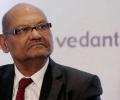
Indian lenders are unlikely to clear the vertical split of BSE-listed Vedanta Ltd in a hurry, considering that the demerger would reduce the fungibility of cash flows across businesses and increase their volatility, according to analysts. The demerger plan, which would result in six separate listed entities, would require approval from shareholders, lenders and other statutory bodies. "We believe that a separate listing of different businesses would reduce the fungibility of cash flows across businesses and increase the volatility of cash flows.

The ministry is of the opinion that there is a need for a rigorous regime for large unlisted companies, in contrast with the current "light-touch" regulation. "There is a defined regime for listed companies, by the Securities and Exchange Board of India (Sebi). "There is a view in the ministry that it needs to look at a framework for large unlisted companies," the senior official said.

The net financial savings of the household sector has moderated to 5.1% of GDP in FY23 from 7.6 per cent in FY20, as households shifted their savings to physical assets amid low interest rates during the pandemic, according to State Bank of India's (SBI) Research report.

The finance ministry on Thursday sought to clarify that there was no distress in household savings and the data indicated that changing consumer preference for different financial products was the real reason for the change in the pattern of household savings. The clarification comes in the backdrop of Reserve Bank of India data showing that household net financial savings rate is at its lowest in decades, at 5.1 per cent of GDP in FY23 compared to 7.2 per cent of GDP in FY22. The divergence in the data for household gross financial assets and liabilities is not a cause for concern for the government, as the loans have largely been taken to buy real assets or automobiles, the finance ministry said.

'To get a 100 per cent consensus document without any reservation, any bracket, any chair summary is unprecedented in the history of multilateral forums.'
Showing the effect of the slowdown in global economic activity, the equity foreign direct investment (FDI) into India declined sharply to $13.9 billion in April-July 2023 from $22.04 billion a year ago. The net FDI, inflows minus outflows, declined from $17.28 billion in April-July 2022 to $5.70 billion in April-July 2023 on account of moderating gross FDI and a rise in repatriation. Gross FDI into India moderated to $22.0 billion during April-July 2023 from $29.6 billion a year ago, according to Reserve Bank of India data.

The Reserve Bank of India's (RBI's) decision to withdraw the incremental cash reserve ratio (I-CRR) is expected to benefit banks during the festival season. They are likely to increase deposit rates by up to 25 basis points (bps) in select maturity buckets. The rise in demand for funds to cover tax payments and meet quarter-end business targets could influence rate decisions by banks, according to bankers and money market executives.

Auditors seem to have developed a heightened sense of risk and are not content to tick the boxes and sign the papers.

'I'm pitching India for the strengths we offer, including the English language, engineers, doctors, nurses, professionals, innovative talent of startups.'

Reflecting subdued global economic growth, India's outward foreign direct investment (FDI) fell by 33.3 per cent sequentially to $1.21 billion in August, compared to over $1.82 billion in July.

As a step to entrench its consumer finance business, Bajaj Finance (BFL) plans to scale up its business-to-business (B2B) activity, both in terms of volume as well as value. It plans to add up to 1,000 cities in the next three years and this will mark its presence in around 5,000 cities. The expansion activity will be more in Northern and Eastern India.

Crypto assets should not be granted official currency or legal tender status, the much-awaited synthesis paper by the International Monetary Fund (IMF) and Financial Stability Board (FSB) has said ahead of the G20 leadership summit under India's presidency. However, the report has argued against a blanket ban on activities linked to crypto assets, explaining that such a move can be costly as well as technically demanding to enforce. Central banks should avoid holding crypto assets in their official reserve as they pose a risk to monetary and global financial stability, according to the synthesis paper.

The Competition Commission of India has introduced draft regulations for combinations or mergers, under the new competition Act, to bring global deals in the digital space, including those involving Big Tech companies, under its scanner. The draft regulations would provide guidance on the valuation of merger transactions and the criteria for assessing sustainable operations in India for companies. The proposed rules mention that if the number of users and subscribers, or the turnover or gross merchandise value in India is over 10 per cent of the global figure, the company would be considered to have substantial business operation in India and would need CCI approval for the merger.
 © 2026 Rediff.com - Investor Information - Advertise with us - Disclaimer - Privacy Policy - Sitemap - Feedback - About us - Terms of use - Grievances